
"Both India and China are victims of terrorism and the region was suffering from the menace. The prime minister said no country is immune from terrorism and on this issue, we cannot afford to have any differences," MEA spokesperson Vikas Swarup told reporters after the meeting.
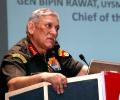
'We should not treat each other as rivals. We should make cooperation the mainstream, China said.

'Both have a very nationalistic view of foreign policy.' 'They think they are shrewd and clever diplomats.'
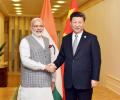
'At the informal summit, the two leaders will have heart-to-heart discussions on overarching issues and try to build mutual trust'
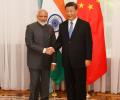
'The fact that Modi and Xi exuded confidence to accelerate the negotiations for a border settlement alone underscores that the Russia-India-China triangle has become very dynamic,' notes Ambassador M K Bhadrakumar.

Against the backdrop of recent incursions by Chinese troops into India, the two countries are working to conclude a new border defence agreement with an aim of signing it when Prime Minister Manmohan Singh travels to Beijing possibly in October.

Trump also said he will no longer allow North Korea to continue with its belligerent behaviour.

Ahead of Prime Minister Narendra Modi's Beijing visit, a state-run newspaper on Tuesday carried a highly critical article of him.
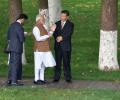
'The meeting marks the first tentative step in the effort to understand whether the two largest Asian nations can co-exist peacefully while realising their aspirations.' 'Caution and watchful wariness will dominate the effort of both sides,' says Jayadeva Ranade, former RA&W officer and China expert.

Putin, 62, who holds an 8th dan black belt in Karate, said, "I do not know how to do yoga. When you people do it, it looks difficult. That is why I have not tried it."

Modi said India will continue its support to ASEAN for a rules-based security architecture for the region.

China on Monday said India's membership bid in the NSG has become "more complicated" under the "new circumstances" as it again ruled out backing New Delhi's entry in the grouping, saying there should be non-discriminatory solution applicable to all non-NPT signatory countries.

Narrowing of differences on competing territorial claims along the un-demarcated LAC might take weeks, if not months, of hard-nosed negotiations. Without some give and take on both sides, the impasse will be hard to resolve, observes Virendra Kapoor.

That Australia is ready for a substantive engagement is evident from its 2013 Defence White Paper, which emphasised the need to build stronger defence relations with India, says Ajai Shukla

'Problems will keep recurring unless China vows to resolve all outstanding issues between the two sides,' says Sana Hashmi.
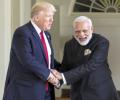
Trump lauds Modi, saying he has been working successfully to bring the vast country and its people together.
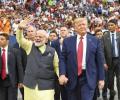
'Modi skillfully navigated Trump's ego and pushed the right buttons.' 'Critics assailed Modi's speech for its personalism, but in the Trump era this is par for the course.'

'Chinese leaders rarely receive their foreign guests in cities other than Beijing. Such respect for India!' 'Does it mean that Modi could replicate "the warmth and unconventional way" by sending Indian troops into Tibet, as Xi did in Chumur (Ladakh) when he arrived in India? Of course, Indians are far too polite to do so,' says Claude Arpi.

Both sides to enhance cooperation in combating international terrorism.

Nevertheless, border dispute will feature prominently on Modi's agenda but the matter won't be discussed at length. Nayanima Basu reports
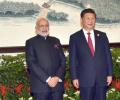
Prime Minister Narendra Modi and Chinese President Xi Jinping have agreed to make efforts to put India-China ties in the "right direction" and to "respect and accommodate" each other's concerns to avoid "impedance" relations, a top Chinese diplomat said on Tuesday.
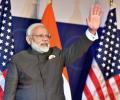
PM Modi addressed the Indian community in Washington DC after meeting chief executives of major US companies.

'India does not wish to remain silent in improving its strategic space so that its leverage to counter China's expansionist designs is maintained, besides enabling it to play a responsible role from a position of strength for peace and stability in Asia,' points out Dr Rajaram Panda.

India insisted that PM Modi and Chinese President Xi Jinping held "conversation on range of issues" in Hamburg.

Both India and China have realised that if border incursions keep reoccurring, other issues of mutual interest will remain unstable. Sheela Bhatt reports

India and Japan on Friday sought a peaceful solution to the territorial disputes in the strategic South China Sea, saying parties involved in the matter must not resort to "threat or use of force", in remarks that could anger China which is opposed to any outside interference.

The conference was attended by envoys of Pakistan posted at Washington, Beijing, New Delhi, Afghanistan, UN New York, UN Geneva, Vienna, Brussels and Moscow among others.
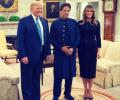
'Trump's new discovery is that Pakistan and its army are virtually god's gift to mankind.' 'They are required to facilitate a relatively orderly American exit from Afghanistan,' points out Ambassador G Parthasarathy, who served as India's high commissioner to Pakistan.

The readouts by the Indian and Chinese sides on the meeting on Monday between External Affairs Minister Sushma Swaraj and her Chinese counterpart Wang Yi in Moscow bring out that divergences are crowding into the centrestage of their relationship, says Ambassador M K Bhadrakumar.
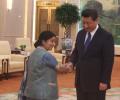
'This is a US-India effort and it is not necessarily to counterweight anyone.'

Iran's decision to keep India out and welcome China to the scene is a huge strategic setback for India, observes Dr Rajaram Panda.

Any move by India to join the US navy for jointly patrolling the disputed South China Sea will be against its national interest, would divide Asian countries and further escalate regional tensions, a state-run Chinese daily said on Friday.
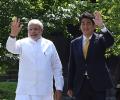
Although the India-Japan relationship has its own driving forces in terms of robust economic ties and shared values, China is the elephant in the room in the strategic parleys between the two countries, says Rup Narayan Das.

It is the first meeting between the two leaders after India boycotted the high-profile Belt and Road Forum.

'Trump forgets that Kim is not one who likes to be treated publicly as a pauper; he wants to come to the table as an equal, and from a position of perceived strength, not as a suppliant,' says Dr Rajaram Panda.

Ambassador Natarajan Krishnan and Ambassador Shankar Bajpai helped shape Indian foreign policy at a glorious, but difficult, time in history, recalls Ambassador T P Sreenivasan.

From early indications, the Modi government's foreign policy seems to be pragmatic and reciprocal, says K G Suresh.
Dr Manmohan Singh would be faced with very few choices in Beijing given the Chinese conceived notions of the world today and India's low place in their calculus, says Srikanth Kondapalli.
Basit was called in by Foreign Secretary S Jaishankar to convey India's strong views on the incident, the external affairs ministry said.

Lu said China will take 'further action' to safeguard its sovereignty.
